Hi everyone,
The best-run sites do not just manage contractor compliance. They create contractor readiness.
- You can feel the difference immediately.
- Contractors arrive ready.
- Approvals are aligned.
- Permits do not need last-minute rescue.
- Supervisors are not chasing documents at the gate.
- And the job starts with less noise.
That kind of calm does not happen by accident. It is built.
This month, I want to look at why the strongest industrial companies treat contractor control as something much bigger than admin or compliance. Done well, it improves start-up speed, reduces friction, lowers hidden cost and gives teams far more confidence in the way work is prepared and executed.
That is not just a nice operational ideal. Recent European evidence points in the same direction. Belgium’s latest social dumping report shows enforcement is becoming more targeted and data-driven, with 8,298 cross-border fraud and social-dumping investigations in 2025, at least one infringement in 41.6% of those cases, and over 63% of data-mining-selected sites leading to findings. The same report notes 918 A1 documents were withdrawn and 861 fictitious A1 documents were identified. In plain English: weak contractor control is getting easier to detect.
At the same time, the OECD’s new mapping of due diligence legislation shows how the expectation is broadening across jurisdictions. It maps 21 legislative measures in 11 jurisdictions and shows a common pattern: companies are increasingly expected not just to state policies, but to identify risks, prevent harm, track implementation, communicate clearly and support remediation across operations and supply chains.
And the European Parliament’s February work on subcontracting chains points the same way. More transparency, clearer employer obligations and tougher attention to labour intermediation all push companies toward tighter control over who is working through which chain, under which conditions, and with which responsibilities.
So here is the myth I want to challenge this month:
Contractor control is not mainly a compliance issue. It is a performance issue with direct financial consequences.
1. The hidden cost is rarely the missing document
A missing document is annoying.
What it really represents is expensive.
One unresolved legal check or expired certificate rarely appears in the books as “contractor control failure”. It shows up as a delayed start. A supervisor call. A permit that needs rework. A crew waiting outside. A contractor who is physically present but not practically ready.
That is why so many companies underestimate the cost of poor contractor control. They see the paperwork. They do not see the interruption pattern around it.
The financial leak is not the certificate itself. It is the drag created by everything around it.
And once you see that, the conversation changes.
You stop asking, “Do we have the documents?” You start asking, “How much margin are we losing because readiness is not under control before the gate?”
That is a much better question. It is also a much more uncomfortable one.
2. The best companies reduce friction before work starts
The strongest sites do not win by becoming better at fixing gate problems in real time.
They win by making sure fewer gate problems exist in the first place.
That sounds obvious. Yet a surprising number of contractor models still rely on heroics. Somebody spots an issue late. Somebody calls around. Somebody “just gets it sorted”. Everybody moves on and tells themselves the process worked.
It did not work. A person worked around a weak process.
Recent EU-OSHA work on labour inspectorates and prevention services is useful here. The report, published in March, draws on multiple national studies and shows that stronger compliance comes from systems that support safe and consistent execution, not only from sanctions after the fact. That matters because industrial control does not fail on policy language. It fails in the gap between approval and execution.
That gap is usually very specific:
- approved contractor, wrong worker
- approved worker, wrong task
- approved task, missing permit logic
- approved permit, unresolved access condition
This is where friction starts. And friction is rarely neutral. It consumes attention, time and output.
3. The contractor chain is now a control chain
A lot of organisations still manage contractors as if each supplier is an island.
They are not.
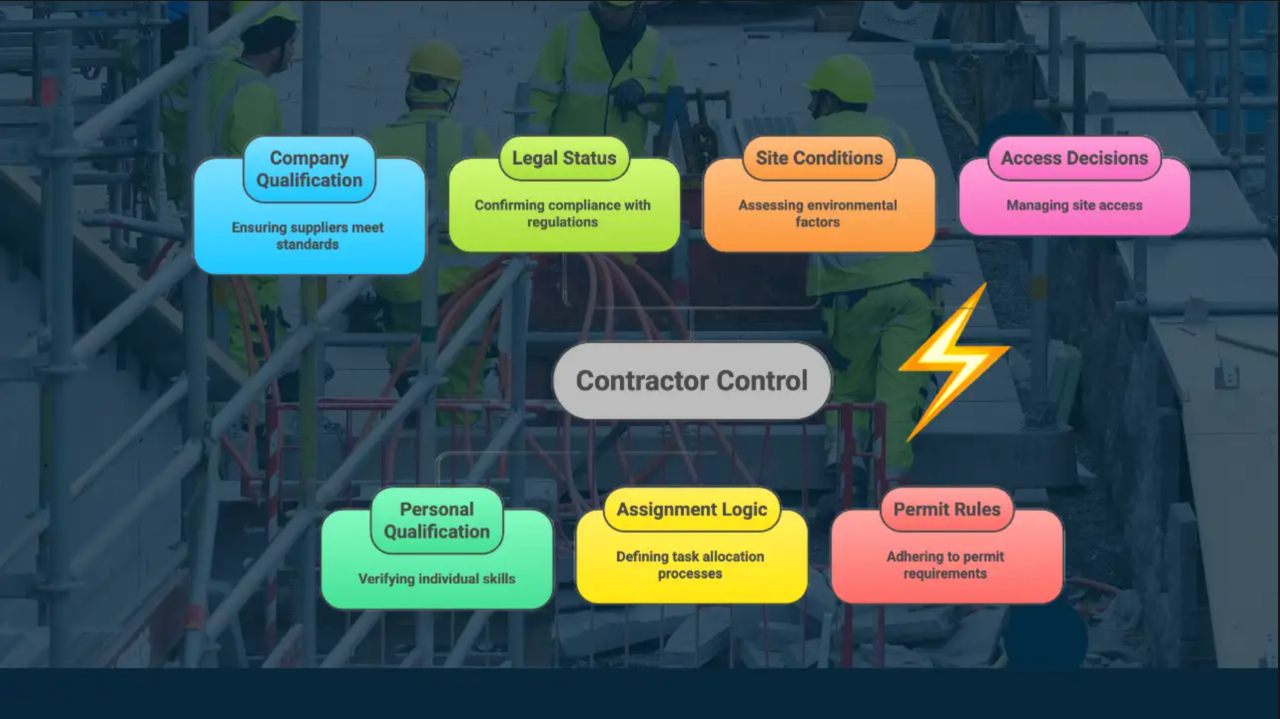
They are part of a chain of company qualification, personal qualification, legal status, assignment logic, site conditions, permit rules and access decisions. Once one link is weak, the whole chain becomes noisy.
That is why the European debate on subcontracting matters far beyond policy circles. The Parliament’s recent focus on abusive forms of subcontracting and labour intermediation is not just about worker protection in the abstract. It reflects a broader reality: as contractor chains become more layered, control becomes harder unless companies rebuild visibility and ownership deliberately.
This is also why some of the most common comfort phrases on site are not actually comforting. “The documents were uploaded.” “The team knows them.” “We usually solve that at the gate.”
That is not control. That is industrial folklore.
Real control means you can answer, fast and with evidence:
- Which company was approved?
- Which people were attached to the scope?
- Which legal checks were completed?
- Which task were they approved for?
- Which permit conditions applied?
- Who signed what?
- Why was access granted?
If those answers take too long, the process is weaker than it looks.
4. Supply chain safety and site readiness are the same conversation
This is where many companies still split one reality into two departments.
They talk about safety in one meeting. Supplier governance in another. Permits somewhere else. Access somewhere else again.
But the site experiences all of that as one flow.
EU-OSHA’s new supply-chain work states it plainly: the way companies manage their supply chains has a profound impact on workers’ safety and health. That is a useful correction, because it pulls safety out of the narrow “training and PPE” frame and puts it back where it belongs: inside the way work is organised, approved and executed across multiple companies.
In practice, that means contractor readiness is not just about being legally covered.
It is about whether work can start cleanly. Whether decisions line up. Whether roles are clear. Whether exceptions are closed before arrival. Whether the site absorbs less noise.
That is where continuity lives. And that is also where hidden cost either grows or gets removed.
The boring path to excellence
There is no magic move here.
The companies that get this right do a few very unglamorous things consistently.
⚡️They define ownership. ⚡️They standardise qualification logic. ⚡️They connect legal checks to actual people and actual scopes of work. ⚡️They make permits part of the operational flow, not a separate ritual. ⚡️They treat access as the consequence of readiness, not as the place where readiness is discovered. ⚡️And they close open loops before the contractor reaches the site.
This is not flashy transformation language.
It is disciplined control design.
And in a market where enforcement is getting sharper, due diligence expectations are broadening and subcontracting chains are under more scrutiny, disciplined control design starts to look a lot like competitive advantage.
So here is the question I would leave with you this week:
If contractor readiness improved tomorrow across all your sites, would you notice it first in compliance, or in margin?
Together, we tackle the challenges of contractor management,
ensuring you have the support you need

“We raden Onyx One zonder twijfel aan! Heel wat van onze huiscontractoren werkten al met het systeem en dit heeft ons overtuigd. We zijn tevreden over het platform en over de samenwerking.”
Fons Huybrechts
Operationeel Preventie Adviseur – Bayer Agriculture bv
“Onyx One verbeterde aanzienlijk ons contractor management. Alle documenten en certificaten worden nu automatisch opgevolgd. Het is een gebruiksvriendelijk systeem en ze beschikken over een sterke servicedesk.”
Diana De Peuter
Finance and IT Manager – Monument Chemical bv
“We hebben via Onyx One een uitstekende veiligheidsopleiding (e-Learning) voor de contractors en de samenwerking verloopt vlot.”
Luc Dejonghe
HSSE Manager – Shell Catalysts & Technologies Belgium N.V.