It’s 06:11, and your site is already negotiating with time. The cleaning team is early. Maintenance has a tight permit slot. A specialist fitter shows up as a last-minute swap because the original guy is sick. Security asks for verification. Operations wants the work to start. Procurement says we have a contract. The contractor says we’re ready, just open the gate. And that’s when chain liability stops being a legal topic and becomes what it really is in 2026: a throughput problem with legal consequences.
Europe’s industrial context is not forgiving right now. Cost pressure is relentless. Headcount is thinner. Shutdown windows don’t stretch. And ‘we’ll fix it later’ has become the most expensive sentence on site.
That’s why my newsletter comes with a practical internal handover document: Download the Chain Liability 2026 Proof Pack (PDF). This newsletter is the briefing. The PDF is the operational kit you can forward to Security, Permits, Procurement, and your contractors.
A contract clause feels like protection. Well, it is not.
Today the safest clause in the world will not help you at 06:11 at the gate. When pressure hits, nobody asks Procurement to read out legal wording. They ask one operational question: “Show me what you checked, and when.” That is the real shift, from paper comfort to proof reality.
A clause is a promise. Proof is a timeline you can replay: you requested the right items, you received them, you checked them, you logged a decision, and you handled exceptions. If you cannot show that timeline fast, you do not just carry legal exposure. You create operational drag. Work pauses, permit slots slip, supervisors start chasing documents, and the contractor keeps billing while your site argues with itself.
So here is the rule for 2026: your contract sets expectations. Your evidence trail keeps the work moving.
The shift since the start of this year
Since the start of this year, Flanders has tightened chain liability rules linked to illegal employment of illegally staying third-country nationals, with a focus on defined risk sectors (including construction, cleaning, meat, and certain parcel activities).
The operational impact is straightforward. If your direct contractor or subcontractor is in a risk sector, you are expected to have a written declaration and demonstrable due diligence, meaning you can prove you requested and verified the relevant evidence.
Outside those risk sectors, the written declaration remains the key requirement. The change you will feel on site is this: it is no longer enough that documents exist somewhere. You must be able to show a clean verification trail before work starts, not at the gate.
International readers: do not copy the Flemish scope. Copy the mechanism. Evidence trails are replacing good intentions.
What this changes on an industrial site
The law does not just want documents to exist somewhere. It expects due diligence to be demonstrable. Operationally, that means you can show a clear verification trail: what you requested, what you received, what you checked, who decided, and when. And you need it before work starts, not when a queue forms at the gate.
International readers: this is Flemish law. Do not copy the scope into your country. Copy the mechanism. Regulators increasingly test evidence trails, not intentions.
1) Where exposure grows without notice
Chain liability rarely blows up during the big hero projects with a war room and months of prep. It blows up in routine industrial work: maintenance between production runs, recurring cleaning scopes, scaffolding and insulation packages, shutdown work across multiple tiers, and constant substitutions.
Your organisational chart thinks in terms of suppliers. Your site runs on people arriving today. The chain becomes invisible until something goes wrong.
The money leak is not one dramatic event. It is small friction, repeated daily: supervisors chasing proof instead of supervising work, permits restarted because names do not match, security doing detective work at peak hours, and “temporary exceptions” that slowly become the real process.
What proof looks like, at the principle level, is simple: chain clarity. For any work package, you can show who is in the chain, who is assigned to which tier, what checks were required and done, and who approved, blocked, or allowed access with conditions.
How you scale it is also simple: chain visibility becomes a condition of onboarding. Tier disclosure happens before arrival. Substitutions trigger a controlled update, not a gate debate. Proof ownership is assigned to one accountable role. The PDF holds the templates that make this boring, which is exactly the point.
2) Why gate checks create friction and conflict
When you push verification to the gate, you turn the gate into a decision engine. The gate is built for access control, not for document interpretation, chasing missing items, or handling high-pressure exceptions. So the gate becomes a negotiation.
“It’s urgent.” “They worked here last month.” “Procurement approved.” “We’ll send it later.” -> ik maak hier een visual van
That is not control. That is improvisation, while your asset clock ticks. Gate friction is expensive because it creates one brutal pattern: stop, then restart. Miss a permit slot, and you do not just lose minutes. You lose the sequence: escorts, isolations, tool time, supervision rhythm, and sometimes the whole day plan. And yes, contractors will still bill while your site argues with itself.
What proof looks like here is not complicated. The gate should not discover compliance. The gate should confirm status. Three statuses are enough: approved, conditional, and blocked.
To build it at scale, you move checks upstream and standardise decisions. No first-time proof checks at the gate. Approvals and exceptions happen before arrival. An urgent lane exists, but it is formal, with clear authority, clear logging, and clear conditions. The PDF contains the urgent lane playbook, because that is where most sites lose control.
3) The evidence stack that survives audits
Most sites have documents. Fewer sites have evidence. A folder is not evidence. An email chain is not evidence. Evidence is a time-stamped narrative you can replay: you requested, you received, you checked, you decided, you followed up.
This is where money quietly disappears. Engineers searching drives before an audit. HSE reconstructing who was actually on site. Procurement pulling contracts that answer the wrong question. Managers building timelines late at night. If proof is assembled after the fact, it will cost more and look weaker.
At principle level, your evidence stack should be able to show three things: the declaration exists where required, diligence steps were taken where required, and decisions and follow-up are recorded in a way you can retrieve fast.
To scale it, you design the workflow so evidence is a by-product. Verification events are logged automatically. Retrieval is designed for ten minutes under pressure, not a day of digging. Substitutions are supported because substitutions are normal. The PDF contains the minimum evidence fields and the retrieval checklist.
4) Exceptions and escalation without chaos
Documents will be missing. Something will expire. A subcontract tier will show up late. A crew will arrive with a different composition. If your process is “let them in and fix later,” you do not have an exception process. You have a shadow process.
Shadow processes are expensive. They trigger rework: reissued permits, interrupted isolation planning, rebooked equipment, rescheduled escorts, and supervisors doing admin instead of supervision.
What proof looks like in exceptions is a clean trail: what failed, who decided, under which conditions, what deadline was set, and what follow-up happened.
To scale it, run three lanes: green approve, amber conditional with controls and deadline, red blocked with replacement required. Then define escalation: who can authorise amber, who must be informed on red, and response times that match operational reality. The PDF contains the escalation ladder and the exception decision template.
Key takeaways
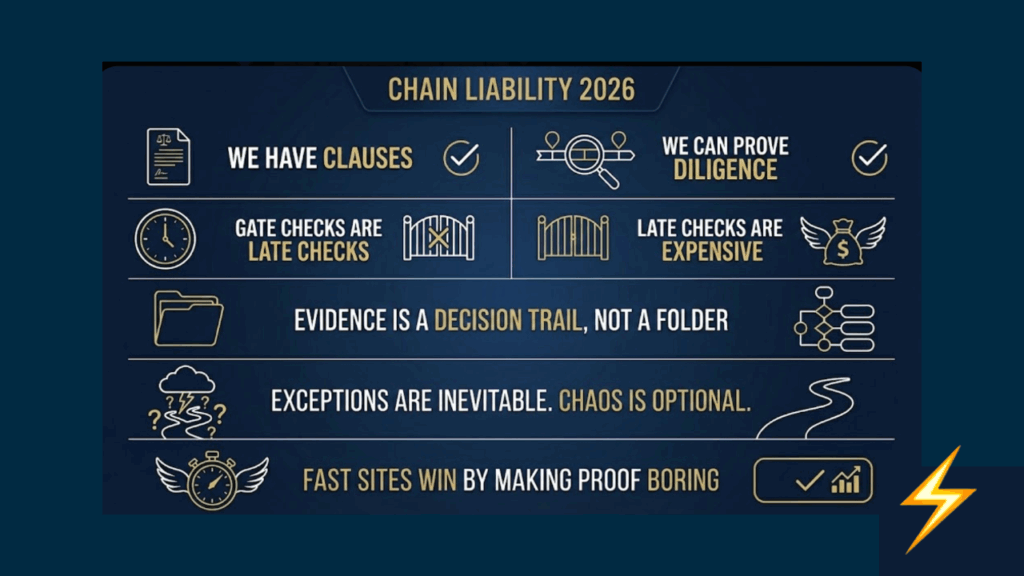
- Chain liability in 2026 pushes from ‘we have clauses’ to ‘we can prove diligence.’
- Gate checks are late checks, and late checks are expensive.
- Evidence is a decision trail, not a folder.
- Exceptions are inevitable. Chaos is optional.
- Fast sites win by making proof boring.
Are you proof-ready before the gate?
Do you know every tier for tomorrow’s critical work? Are crews pre-cleared before arrival? Does the gate see a clear status: approved, conditional, blocked? Can you show who approved access and on what basis? Can you retrieve an evidence trail in under 10 minutes? Do you have cut-off times aligned with permit start times? Is there an urgent lane that does not bypass diligence? Are substitutions handled without restarting the whole workflow? Do you classify exceptions with deadlines and controls? Do you measure proof failures and exception volume as operational KPIs?
If you answered NO 3 times, that is not paperwork, that is a throughput leak.
One practical option
Some sites build a dedicated internal proof team that owns verification, exceptions, and evidence retrieval, so operations can focus on uptime. Others outsource proof-work to a managed service (e.g., Contractor Care) so the site does not burn engineering hours on admin reconstruction.
Both can work. The weak model is always the same: proof handled part-time, with no cut-offs, no escalation power, and no single owner.
Closing question
If someone asked you tomorrow morning, ‘Prove your checks for today’s crews,’ would you pull up the evidence in 30 seconds or spend the day paying for downtime that looks like administration?
Together, we tackle the challenges of contractor management,
ensuring you have the support you need

“We raden Onyx One zonder twijfel aan! Heel wat van onze huiscontractoren werkten al met het systeem en dit heeft ons overtuigd. We zijn tevreden over het platform en over de samenwerking.”
Fons Huybrechts
Operationeel Preventie Adviseur – Bayer Agriculture bv
“Onyx One verbeterde aanzienlijk ons contractor management. Alle documenten en certificaten worden nu automatisch opgevolgd. Het is een gebruiksvriendelijk systeem en ze beschikken over een sterke servicedesk.”
Diana De Peuter
Finance and IT Manager – Monument Chemical bv
“We hebben via Onyx One een uitstekende veiligheidsopleiding (e-Learning) voor de contractors en de samenwerking verloopt vlot.”
Luc Dejonghe
HSSE Manager – Shell Catalysts & Technologies Belgium N.V.