Shutdowns as the ultimate test of industrial credibility
Contractor Risks as a Strategic Boardroom Priority
Geert Peter de Oude
At a glance
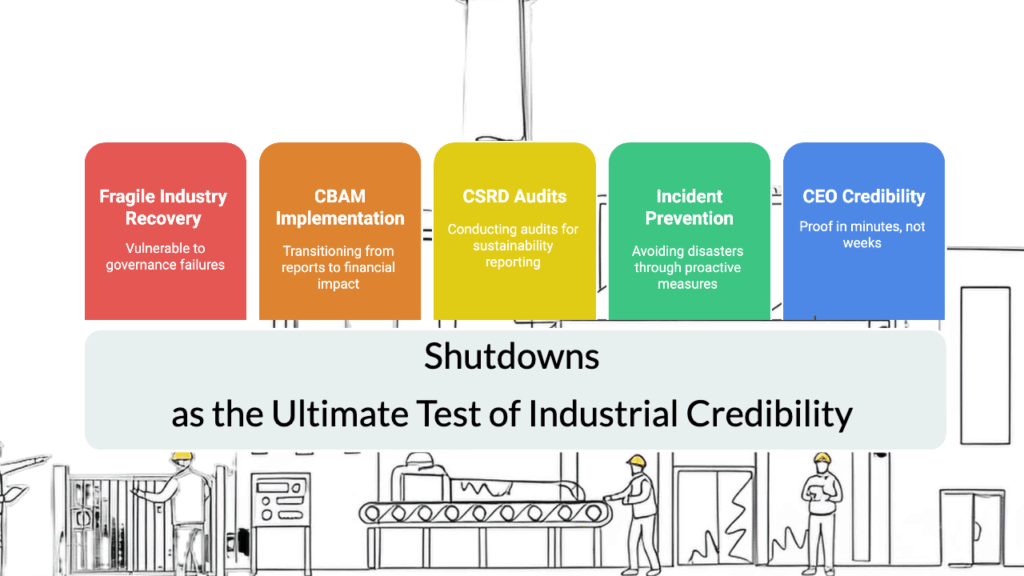
Europe’s industry is showing fragile recovery, but October’s shutdowns and turnarounds reveal where governance truly falls short. CBAM (Carbon Border Adjustment Mechanism) shifts from reports to money, CSRD (Corporate Sustainability Reporting Directive) audits are in motion, and incidents remind us how thin the line is between routine and disaster. For CEOs, proof in minutes, not in weeks, has become the new currency of credibility.
The mood in October: optimism with a catch
The eurozone PMI (Purchasing Managers’ Index) crept back above 50 last month. After years of contraction, it feels like a relief. Yet, sitting in October, we know the story is not that simple. Energy bills remain stubbornly higher than those in other countries, and chemical giants are closing assets. Meanwhile, the Pernis refinery is undergoing a two-month turnaround with thousands of contractors on site. Growth is there, but it is fragile, conditional, and easily derailed.
When regulation walks onto the site
Brussels is no longer a distant backdrop. With the CSRD reporting cycle now underway, boards are discovering that auditors don’t just look at balance sheets; they look at who walked through the gate last week. The CS3D (Corporate Sustainability Due Diligence Directive) adds legal teeth: subcontractors in a turnaround are now part of your official duty of care. And with CBAM moving from dry reports to hard euros, every retrofit project suddenly carries carbon as a line item. Add to that the EU’s forced-labour ban entering its implementation phase, and the message is unmistakable: a shutdown is no longer a purely technical exercise. It is where compliance becomes visible.
The cost of delay, counted in millions
Anyone who has sat through a shutdown review knows the pain of a slipped deadline. In chemicals, a single extra day wipes €1–1.5 million from output. In energy, imbalance penalties clock up by the hour. In pharma, a GMP auditor’s raised eyebrow can condemn entire batches worth tens of millions. These are not abstract numbers. They are the reason CFOs are suddenly present at maintenance briefings.
Incidents don’t start in pipes; they start in gaps
The past weeks made it clear how fragile “routine” can be. A major fire in Veenendaal, an explosion at Synthesia in Pardubice, and a blaze at Teijin Aramid in Delfzijl all underline how quickly normal operations can tip into crisis. In France, a refinery fire at TotalEnergies’ Donges site sent the same signal. Belgium’s Fluxys LNG terminal in Dunkirk faced disruption from a strike, not a safety accident, but a reminder that operational risks also come from labour and logistics. And further east, drone strikes on the Druzhba pipeline and Ilsky refinery highlighted how geopolitical shocks ripple straight into Europe’s energy supply.
What connects these events is not a broken pump or valve. It is the gap between client and contractor, between a permit issued and a qualification unchecked, between expectation and execution. Those gaps are where governance either fails or holds.
Innovation meets congestion
Yes, predictive analytics and digital twins promise more control. But when your spare parts are stuck in a congested port, or your contractors are waiting at the gate because one document expired, the digital promise rings hollow. October brings both realities: Europe pushing AI in industry, while Rhine traffic fluctuates and air cargo capacity shrinks because new aircraft arrive late. The paradox is clear — foresight without execution is just another form of risk.
What the refinery, the grid, and the cleanroom tell us
Chemicals: Pernis shows what scale means. Thousands of external workers coordinated day and night. Without digital linkage between training, qualification, and access, the critical path collapses.
Energy: grid operators in Belgium and Germany are less forgiving.Overruns no longer just hurt OPEX (Operational Expenditure), they trigger penalties. And the weakest link is often not the turbine, but a subcontractor stuck outside the fence.
Pharma: new GMP (Good Manufacturing Practice) guidance under consultation is blunt. Outsourcing and data integrity must be proven, not promised. For shutdowns, that means every external activity must flow seamlessly into the quality file (the official documentation that proves compliance with GMP standards).
Turning contractors into an asset, not a blind spot
Too often, contractors are treated as a problem to be managed. But in truth, they are the make-or-break factor in every turnaround. Qualification before arrival, digital permits tied to training, and audit evidence ready at the click of a button. These are not operational luxuries. They are strategic levers that protect margins, reputations, and even licenses to operate.
What boards should be asking this month
Beyond LTIFR and TRIR, the questions for October are sharper: LTIFR (Lost Time Injury Frequency Rate) and TRIR (Total Recordable Incident Rate) are no longer enough. These are not questions for safety managers alone. They belong on the CEO’s desk, next to EBITDA and energy costs.
Proof as Europe’s new currency
October 2025 teaches us something simple but profound: industrial growth is not measured in percentages alone, but in the credibility to execute under pressure. A shutdown is the moment of truth. It is where compliance, ESG, and operational resilience are tested in the same crucible.
And the decisive factor is no longer whether you comply, but how fast you can prove it. Minutes, not weeks. That is the new currency of trust.
Geert Peter de Oude
CEO at Onyx One – Pioneering Global Contractor Management Through SaaS Excellence & Unmatched Compliance
“We raden Onyx One zonder twijfel aan! Heel wat van onze huiscontractoren werkten al met het systeem en dit heeft ons overtuigd. We zijn tevreden over het platform en over de samenwerking.”
“Onyx One verbeterde aanzienlijk ons contractor management. Alle documenten en certificaten worden nu automatisch opgevolgd. Het is een gebruiksvriendelijk systeem en ze beschikken over een sterke servicedesk.”
Diana De Peuter Finance and IT Manager – Monument Chemical bv
“We hebben via Onyx One een uitstekende veiligheidsopleiding (e-Learning) voor de contractors en de samenwerking verloopt vlot.”
We use cookies to optimize our website and our service.
Functional cookies
Always active
The technical storage or access is strictly necessary for the legitimate purpose of enabling the use of a specific service expressly requested by the subscriber or user, or for the sole purpose of carrying out the transmission of a communication over an electronic communications network.
Preferences
The technical storage or access is necessary for the legitimate purpose of storing preferences that are not requested by the subscriber or user.
Statistics
The technical storage or access used exclusively for statistical purposes.The technical storage or access that is used exclusively for anonymous statistical purposes. Without a subpoena, voluntary compliance on the part of your Internet Service Provider, or additional records from a third party, information stored or retrieved for this purpose alone cannot usually be used to identify you.
Marketing
The technical storage or access is necessary to create user profiles for sending advertising, or to track the user on a website or across websites for similar marketing purposes.