Contractor Risks as a Strategic Boardroom Priority
Contractor Risks as a Strategic Boardroom Priority
Geert Peter de Oude
At a glance
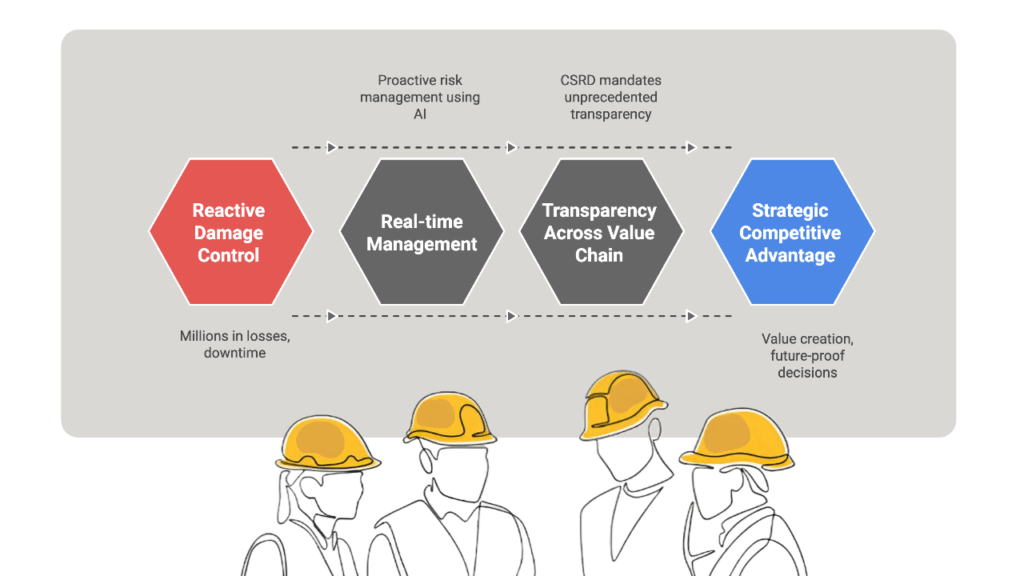
A single contractor-related incident can result in millions in losses, production downtime, and reputational damage.
Contractor accidents and liability cases are on the rise, with far-reaching legal and financial consequences for executives in Belgium and the Netherlands.
New technology and AI enable proactive, real-time management of contractor risks, rather than reactive damage control.
The CSRD mandates unprecedented transparency across the value chain, making contractor governance a strategic competitive advantage.
Read below on how to turn these risks into value creation and future-proof decision-making.
When a contracted engineer failed to conduct a critical safety test at a European refinery, everything changed. The resulting unplanned production shutdown, immediate repair costs, and reputational fallout demonstrated how a single contractor incident can completely disrupt an organisation. Unfortunately, this is not an isolated case in industries where contractor-related risks are increasing at an exponential rate.
The statistics are alarming: according to the most recent data, 3,286 occupational accidents claimed workers’ lives in the EU, while the total economic damage was estimated at €476 billion — representing 3.3% of the European GDP. For CEOs in high-risk sectors in Belgium and the Netherlands, contractor risk management is no longer a mere operational concern. It has become a strategic priority that reaches the boardroom.
The disproportionate risk profile of contractors
The IOGP Safety Performance Indicators reveal a worrying trend. While the contractor’s fatal accident rate has decreased in recent years from 1.62 to 0.87 per 100 million hours worked, it remains significantly higher than the 0.68 recorded for in-house staff. These figures highlight a fundamental problem in current contractor governance. While organisations can control and shape their own safety culture, contractors often remain a “black box” in terms of risk profile and safety performance.
This risk profile is amplified by the complex legal frameworks contractors must comply with. Since 30 July 2018, all legal entities in Belgium, both private and public, can be criminally prosecuted for offences committed within their organisation, following the abolition of the decumulation rule and earlier immunities (Act of 11 July 2018). In the Netherlands, employers have a far-reaching duty of care under Article 7:658 of the Civil Code. This duty applies not only to employees, but also, through paragraph 4, to contracted personnel and other individuals performing work without an employment agreement. Once it is established that the employer has failed in this duty, the employer must prove compliance. Moreover, Article 7:611 of the Civil Code obliges employers to act by the principles of good employment practice, which can result in a reversal of the burden of proof in favour of the injured party.
A Technological Revolution in Contractor Governance
The next generation of contractor risk management leverages predictive analytics and AI-driven risk modelling. Organisations are increasingly deploying real-time dashboards, powered by IoT sensors, smart wearables, and automated compliance tools, to continuously monitor the performance and safety of contracted parties. This shifts the approach from reactive problem-solving to proactive risk prevention, where anomalies are immediately visible and corrective actions can be taken without delay.
AI-powered predictive models combine historical and real-time data to map workplace risks with precision. They analyse environmental conditions, the technical state of equipment, and behavioural indicators of personnel, including fatigue and location data from wearables. Executives thus gain access to strategic dashboards with real-time insights, forecasts of potential incidents, and automated alerts that enable timely escalation and intervention.
CSRD as a Strategic Opportunity
The Corporate Sustainability Reporting Directive (CSRD) transforms ESG reporting from a compliance exercise into a strategic competitive advantage. Its phased implementation began in 2024 for large publicly listed companies, extends this year to all large companies, and from January 1 2026 will also apply to listed SMEs. This timeline allows executives ample opportunity to prepare their contractor ecosystems for the new reporting obligations.
The CSRD mandates a double materiality assessment, requiring organisations to map both the societal impact of their activities and the effect of sustainability risks on their financial position. This “inside-out” and “outside-in” approach extends ESG reporting far beyond traditional financial disclosures.
For contractor management, this means monitoring not only in-house operations but the entire supply chain, including all contractors and subcontractors. While this level of transparency is unprecedented, it also presents significant opportunities for organisations leading in ESG integration.
Double materiality assessments do more than identify risks; they uncover new growth opportunities and strengthen the trust of investors, customers, and other stakeholders. The CSRD is therefore more than a regulatory requirement, it is an essential strategic lens for value creation and future-oriented decision-making.
Geert Peter de Oude
CEO at Onyx One – Pioneering Global Contractor Management Through SaaS Excellence & Unmatched Compliance
“We raden Onyx One zonder twijfel aan! Heel wat van onze huiscontractoren werkten al met het systeem en dit heeft ons overtuigd. We zijn tevreden over het platform en over de samenwerking.”
“Onyx One verbeterde aanzienlijk ons contractor management. Alle documenten en certificaten worden nu automatisch opgevolgd. Het is een gebruiksvriendelijk systeem en ze beschikken over een sterke servicedesk.”
Diana De Peuter Finance and IT Manager – Monument Chemical bv
“We hebben via Onyx One een uitstekende veiligheidsopleiding (e-Learning) voor de contractors en de samenwerking verloopt vlot.”
We use cookies to optimize our website and our service.
Functional cookies
Always active
The technical storage or access is strictly necessary for the legitimate purpose of enabling the use of a specific service expressly requested by the subscriber or user, or for the sole purpose of carrying out the transmission of a communication over an electronic communications network.
Preferences
The technical storage or access is necessary for the legitimate purpose of storing preferences that are not requested by the subscriber or user.
Statistics
The technical storage or access used exclusively for statistical purposes.The technical storage or access that is used exclusively for anonymous statistical purposes. Without a subpoena, voluntary compliance on the part of your Internet Service Provider, or additional records from a third party, information stored or retrieved for this purpose alone cannot usually be used to identify you.
Marketing
The technical storage or access is necessary to create user profiles for sending advertising, or to track the user on a website or across websites for similar marketing purposes.